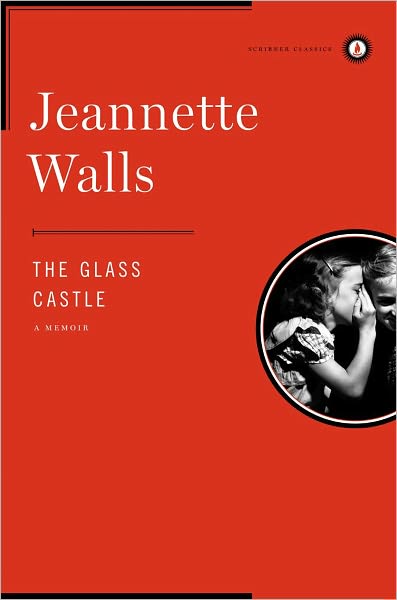
 c2005 Non-fiction; Grades 9+; 288 p. 2006 ALA Alex Award Publisher’s Weekly: Freelance writer Walls doesn't pull her punches. She opens her memoir by describing looking out the window of her taxi, wondering if she's "overdressed for the evening" and spotting her mother on the sidewalk, "rooting through a Dumpster." Walls's parents-just two of the unforgettable characters in this excellent, unusual book-were a matched pair of eccentrics, and raising four children didn't conventionalize either of them. Her father was a self-taught man, a would-be inventor who could stay longer at a poker table than at most jobs and had "a little bit of a drinking situation," as her mother put it. With a fantastic storytelling knack, Walls describes her artist mom's great gift for rationalizing. Apartment walls so thin they heard all their neighbors? What a bonus-they'd "pick up a little Spanish without even studying." Why feed their pets? They'd be helping them "by not allowing them to become dependent." While Walls's father's version of Christmas presents-walking each child into the Arizona desert at night and letting each one claim a star-was delightful, he wasn't so dear when he stole the kids' hard-earned savings to go on a bender. The Walls children learned to support themselves, eating out of trashcans at school or painting their skin so the holes in their pants didn't show. Buck-toothed Jeannette even tried making her own braces when she heard what orthodontia cost. One by one, each child escaped to New York City. Still, it wasn't long before their parents appeared on their doorsteps. "Why not?" Mom said. "Being homeless is an adventure."
Showing posts with label biography. Show all posts
Showing posts with label biography. Show all posts
Tuesday, March 29, 2011
The Glass Castle by Jeanette Walls
c2005 Non-fiction; Grades 9+; 288 p. 2006 ALA Alex Award Publisher’s Weekly: Freelance writer Walls doesn't pull her punches. She opens her memoir by describing looking out the window of her taxi, wondering if she's "overdressed for the evening" and spotting her mother on the sidewalk, "rooting through a Dumpster." Walls's parents-just two of the unforgettable characters in this excellent, unusual book-were a matched pair of eccentrics, and raising four children didn't conventionalize either of them. Her father was a self-taught man, a would-be inventor who could stay longer at a poker table than at most jobs and had "a little bit of a drinking situation," as her mother put it. With a fantastic storytelling knack, Walls describes her artist mom's great gift for rationalizing. Apartment walls so thin they heard all their neighbors? What a bonus-they'd "pick up a little Spanish without even studying." Why feed their pets? They'd be helping them "by not allowing them to become dependent." While Walls's father's version of Christmas presents-walking each child into the Arizona desert at night and letting each one claim a star-was delightful, he wasn't so dear when he stole the kids' hard-earned savings to go on a bender. The Walls children learned to support themselves, eating out of trashcans at school or painting their skin so the holes in their pants didn't show. Buck-toothed Jeannette even tried making her own braces when she heard what orthodontia cost. One by one, each child escaped to New York City. Still, it wasn't long before their parents appeared on their doorsteps. "Why not?" Mom said. "Being homeless is an adventure."

Wednesday, March 23, 2011
The Immortal Life of Henrietta Lacks by Rebecca Skloot
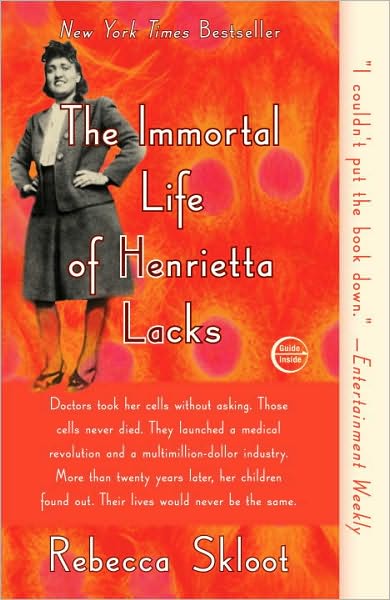 c2010 Non-Fiction; Grades 9+; 369 p.
New York Times Notable Books of the Year 2010 – Nonfiction
Library Journal Best Books Of 2010
Booklist Starred Review: The first immortal human cells, code-named HeLa, have flourished by the trillions in labs all around the world for more than five decades, making possible the polio vaccine, chemotherapy, and many more crucial discoveries. But where did the HeLa cells come from? Science journalist Skloot spent 10 years arduously researching the complex, tragic, and profoundly revealing story of Henrietta Lacks, a 31-year-old African American mother of five who came to Johns Hopkins with cervical cancer in 1951, and from whom tumor samples were taken without her knowledge or that of her family. Henrietta died a cruel death and was all but forgotten, while her miraculous cells live on, growing with mythological intensity. Skloot travels to tiny Clover, Virginia; learns that Henrietta's family tree embraces black and white branches; becomes close to Henrietta's daughter, Deborah; and discovers that although the HeLa cells have improved countless lives, they have also engendered a legacy of pain, a litany of injustices, and a constellation of mysteries. Writing with a novelist's artistry, a biologist's expertise, and the zeal of an investigative reporter, Skloot tells a truly astonishing story of racism and poverty, science and conscience, spirituality and family driven by a galvanizing inquiry into the sanctity of the body and the very nature of the life force.
Tuesday, March 22, 2011
The Life and Times of the Thunderbolt Kid by Bill Bryson
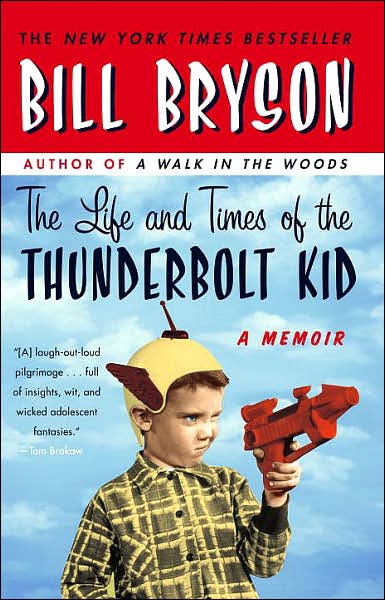 c2006 Non-Fiction; Grades 9+; 270 p.
2007 Book Sense Book of the Year
School Library Journal: The Thunderbolt Kid was "born" in the 1950s when six-year-old Bryson found a mysterious, scratchy green sweater with a satiny thunderbolt across the chest. The jersey bestowed magic powers on the wearer-X-ray vision and the power to zap teachers and babysitters and deflect unwanted kisses from old people. These are the memoirs of that Kid, whose earthly parents were not really half bad-a loving mother who didn't cook and was pathologically forgetful, but shared her love of movies with her youngest child, and a dad who was the "greatest baseball writer that ever lived" and took his son to dugouts and into clubhouses where he met such famous players as Stan Musial and Willie Mays. Simpler times are conveyed with exaggerated humor; the author recalls the middle of the last century in the middle of the country (Des Moines, IA), when cigarettes were good for you, waxy candies were considered delicious, and kids were taught to read with Dick and Jane. Students of the decade's popular culture will marvel at the insular innocence described, even as the world moved toward nuclear weapons and civil unrest. Bryson describes country fairs and fantastic ploys to maneuver into the tent to see the lady stripper, playing hookey, paper routes, church suppers, and more. His reminiscences will entertain a wide audience.
Subscribe to:
Posts (Atom)